

Real estate software in Lebanon:
CRM, portals and 360° tours.
We build real estate software for agencies and developers in Lebanon: the property portal buyers search, the CRM your agents work their leads from, and 360° tours that let a buyer in Dubai or Paris walk through a home before flying in. Listings, leads and viewings live in one system, in English and Arabic.
Where agencies
lose deals
Leads are expensive in real estate, and they go cold fast. A buyer who asks about a flat on Monday has often spoken to two other agencies by Wednesday. Yet in many agencies the lead sits in one agent’s WhatsApp, the listing status lives in someone’s head, and the website is a brochure that drops enquiries into an inbox.
Leads nobody owns
Enquiries arrive from the website, Facebook and Instagram forms, portals and WhatsApp, with no owner and no next step.
Listings out of date
Without one source of truth, an agent sends out a flat that sold last week.
Buyers who can’t visit
Buyers can’t trust listings they can’t visit, and many of them live abroad: the problem KeyDar was built to answer.
A site cheaper than the homes
A luxury agency like Bayview Realty needs its listings, projects and agents to feel as premium online as the properties themselves.
Units that change every week
In a new development, what is available, reserved or sold changes constantly, and buyers expect to see it.
What we build
for real estate
Property portal
Search for sale and rent across regions, budgets and property types, a map that shows the area but never the exact address, and WhatsApp on every listing.
Search in a sentence
Buyers type what they want and it becomes filters, checked against the real listings; KeyDar’s search reads English, Arabic, French and Arabizi.
Agency CRM
Clients, a pipeline board, follow-up rules, viewings in a shared calendar, and deals with their documents and offers.
Smart matching
A buyer’s brief scored against your stock, with the best picks sent on WhatsApp from the same screen.
360° tours
Tours made with a consumer 360° camera: rooms linked through their doorways, a floor plan, and a private link per client that can expire.
New developments
Projects with status labels, payment plans and a building explorer showing which units are available, reserved or sold.
Sellers you can trust
Seller accounts that verify who they are, staff review before a listing goes public, and checks that flag price outliers and copied photos.
Leads in, automatically
Facebook and Instagram lead forms imported into the CRM, and a push notification on the agent’s phone for every new enquiry.
Roles and history
Roles that keep each agent to their own records, and an activity log over everything.
Inside an agency system
The Bayview and KeyDar consoles and KeyDar’s Tour Studio, captured from local copies seeded with invented clients and listings. No real client or home is shown.
Bayview Console (case study)
The console the agency runs on: listings, leads and the team, behind the public portal.
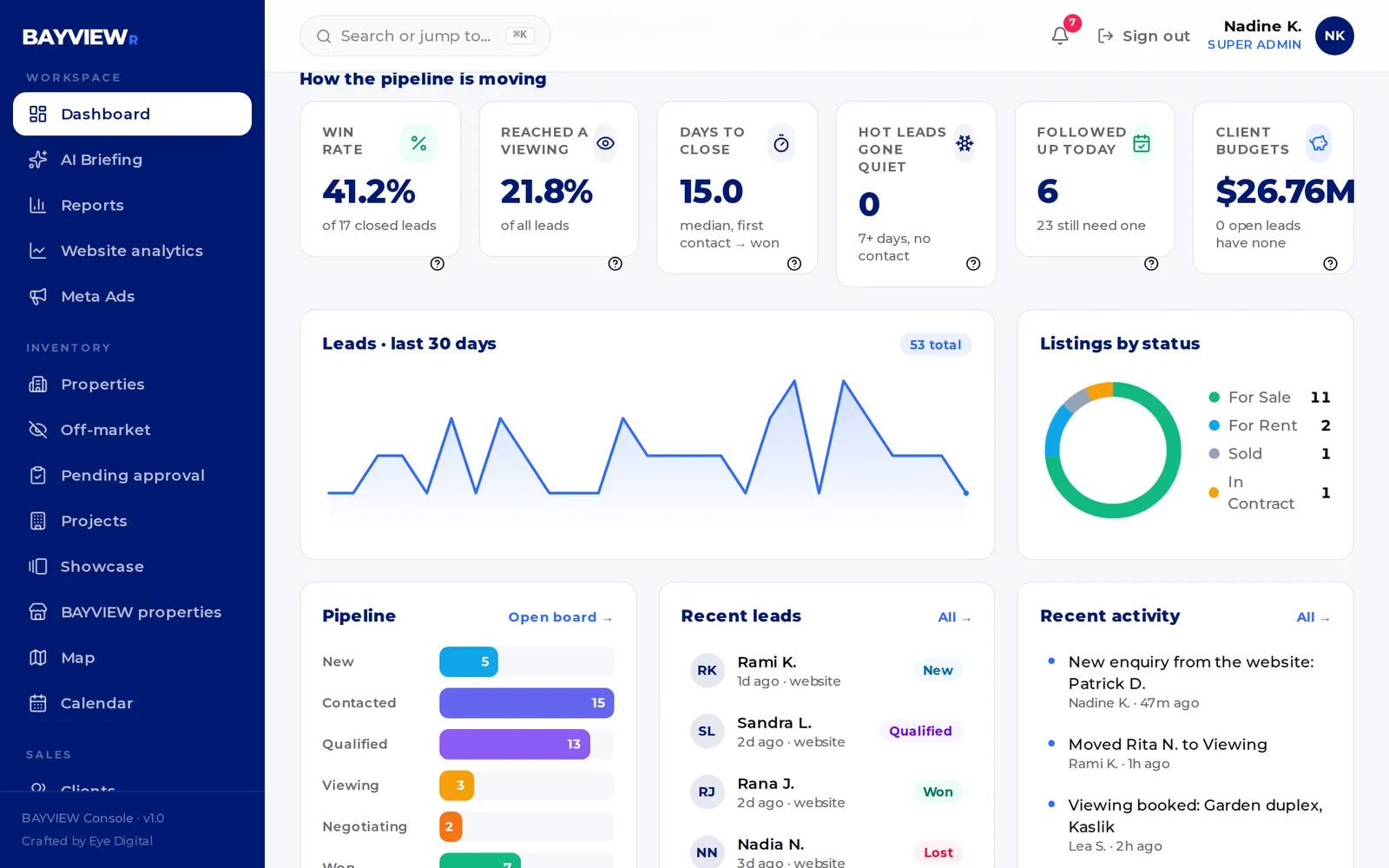
How the agency is doing, at a glance — shown with sample data 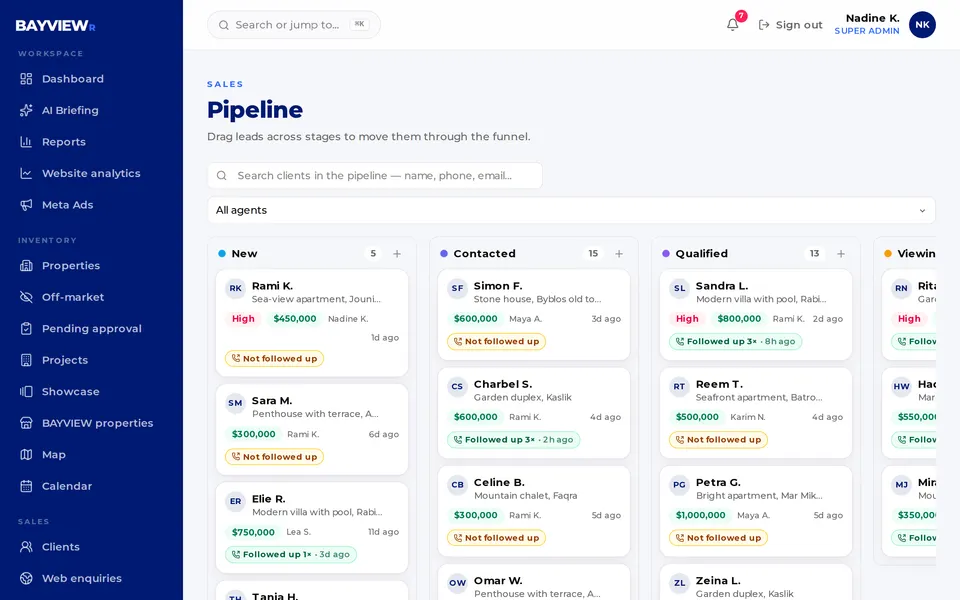
Every client on one board, stage by stage — shown with sample data 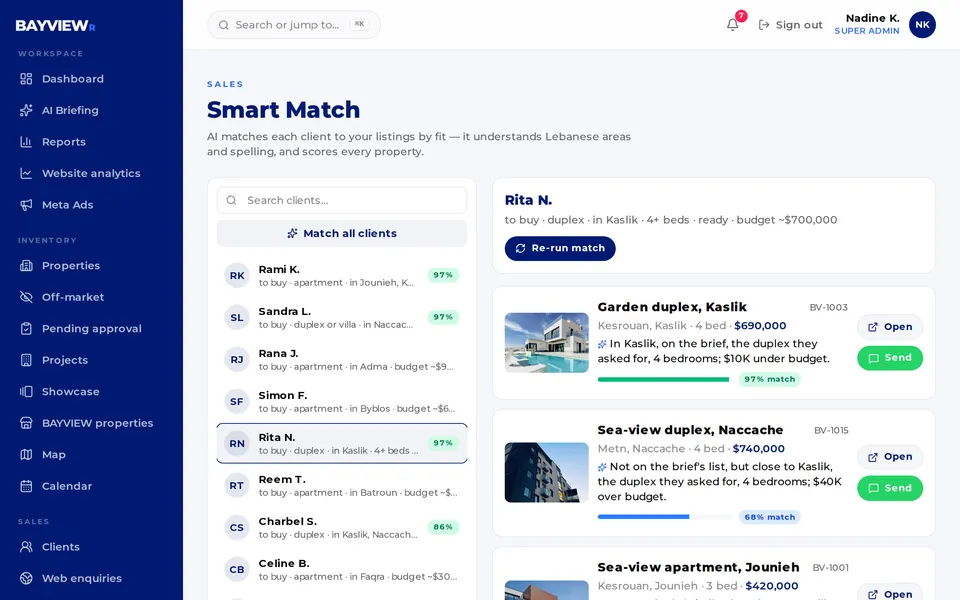
A buyer's brief matched against the stock — shown with sample data 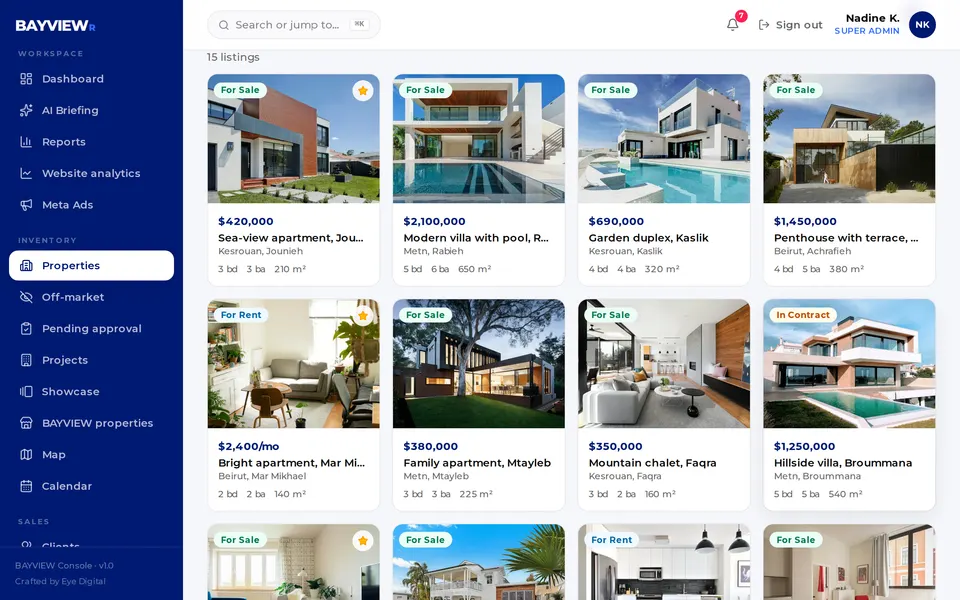
The stock, as the team sees it — shown with sample listings KeyDar Console (case study)
The staff console behind the marketplace: today's work, the pipeline, listings and sellers.
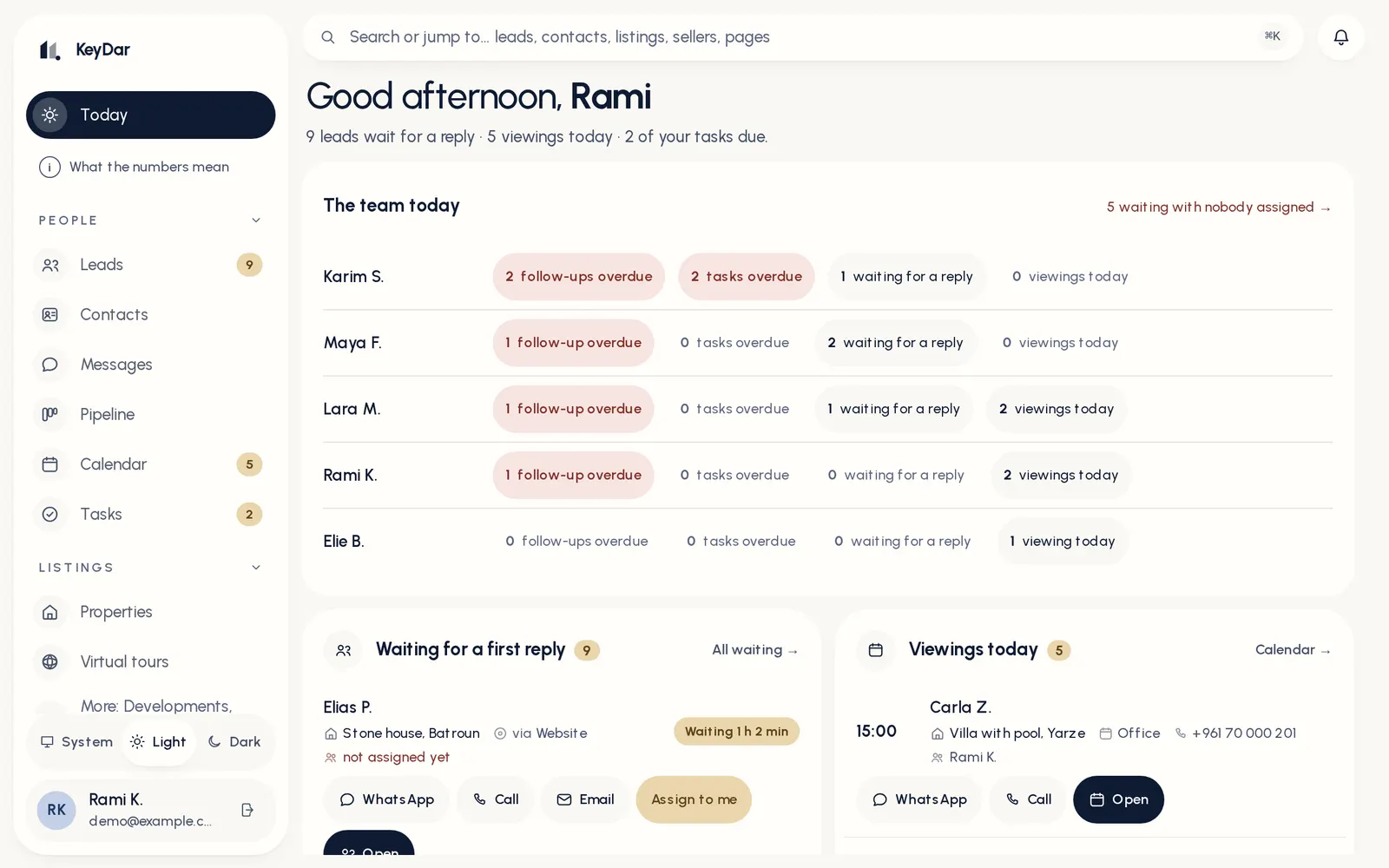
Today: what is waiting on each agent — shown with sample data 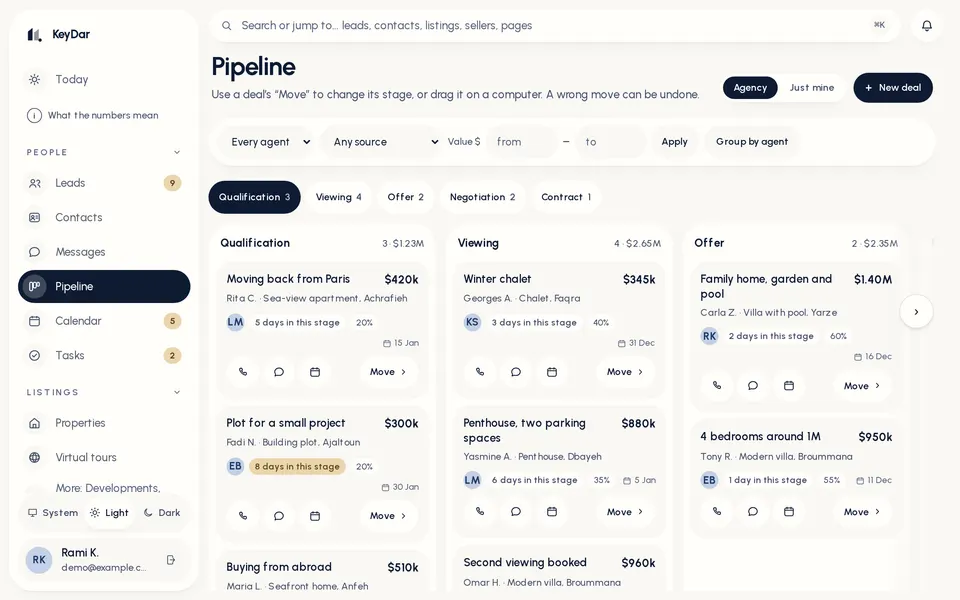
The pipeline, stage by stage — shown with sample data 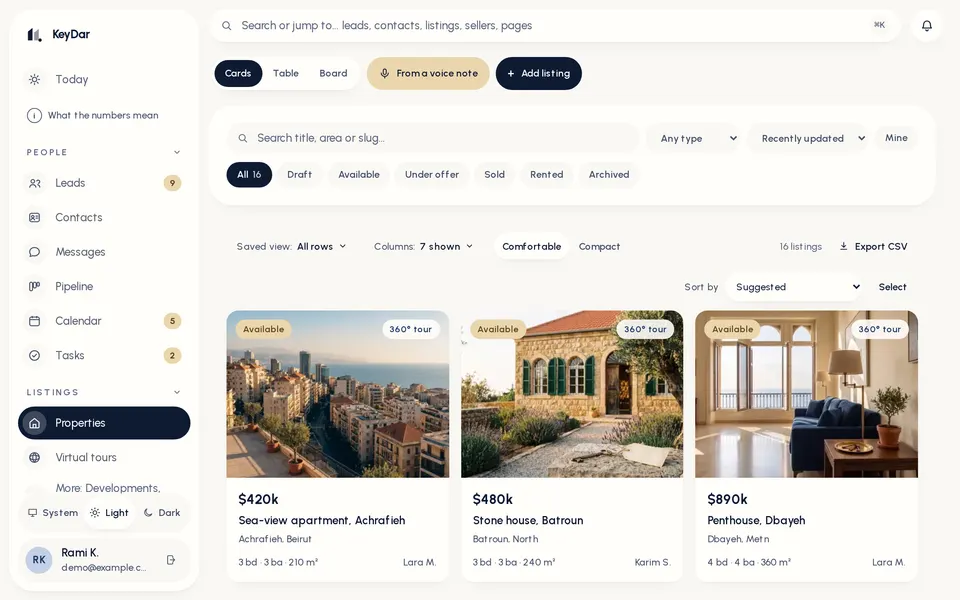
Every listing, with its 360° tour — shown with sample data 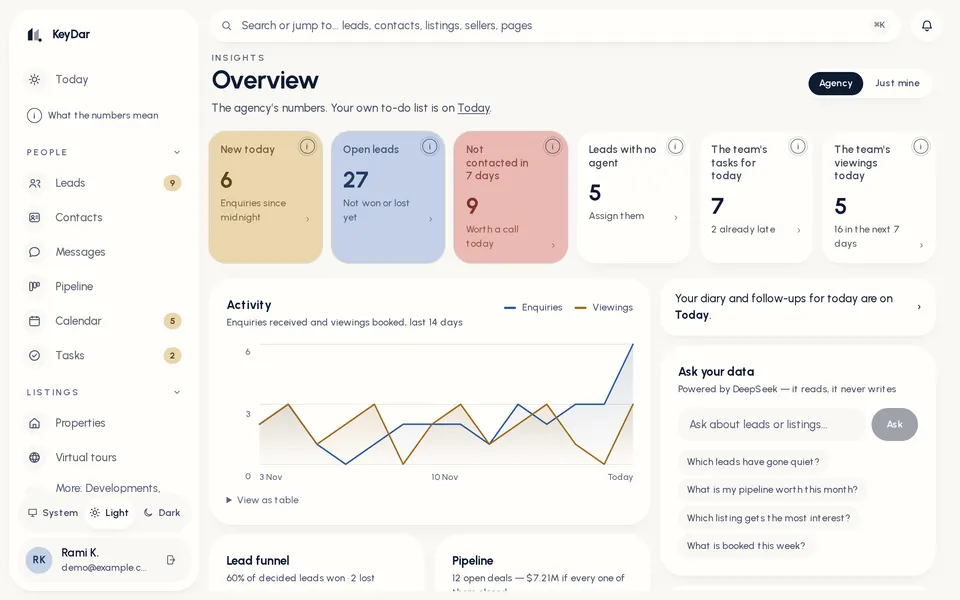
The agency's numbers at a glance — shown with sample data KeyDar Tour Studio (case study)
The 360° tour builder and viewer: shoot a home, walk it room by room, send it as a private collection.
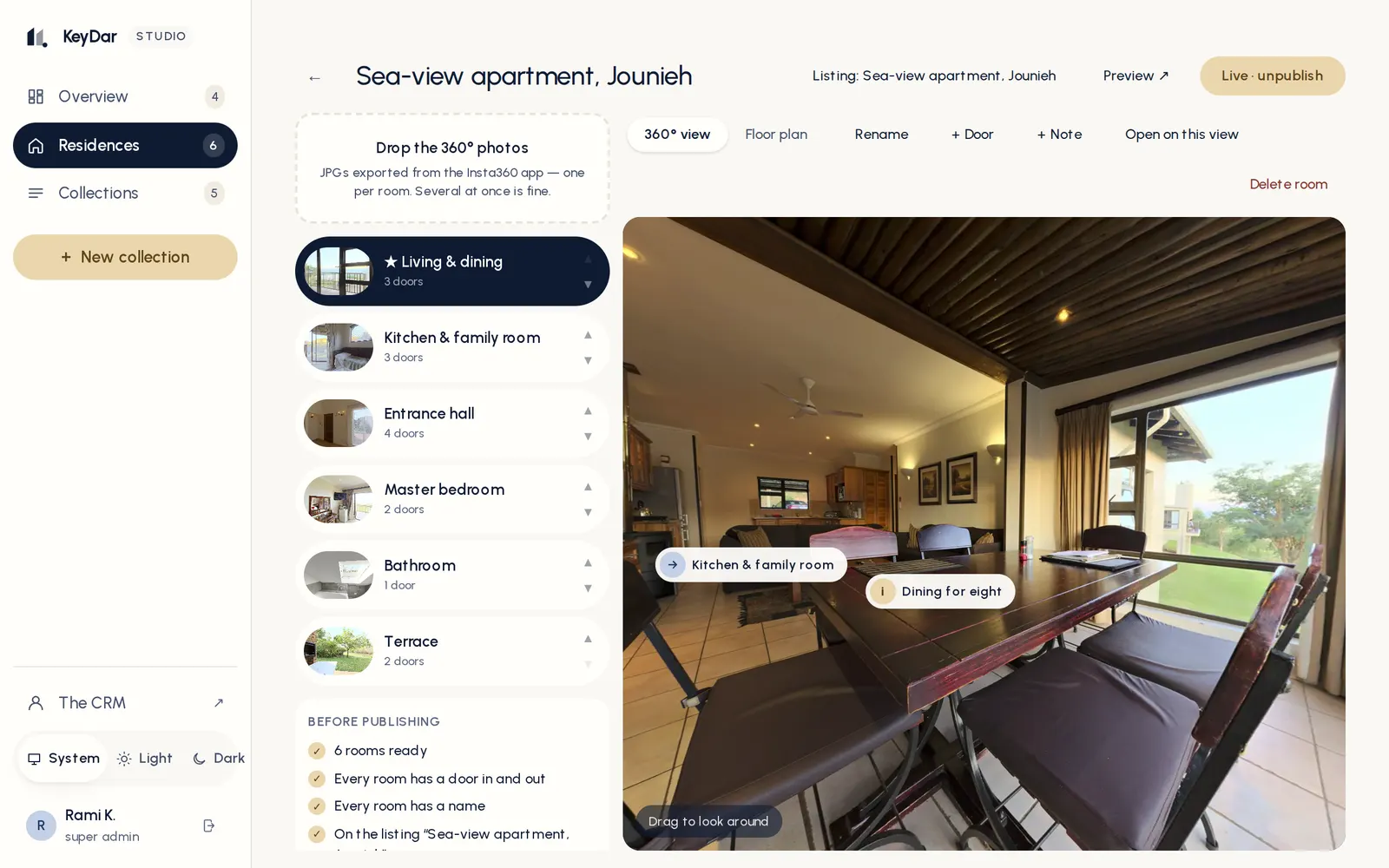
Linking rooms through their doorways — shown with sample data 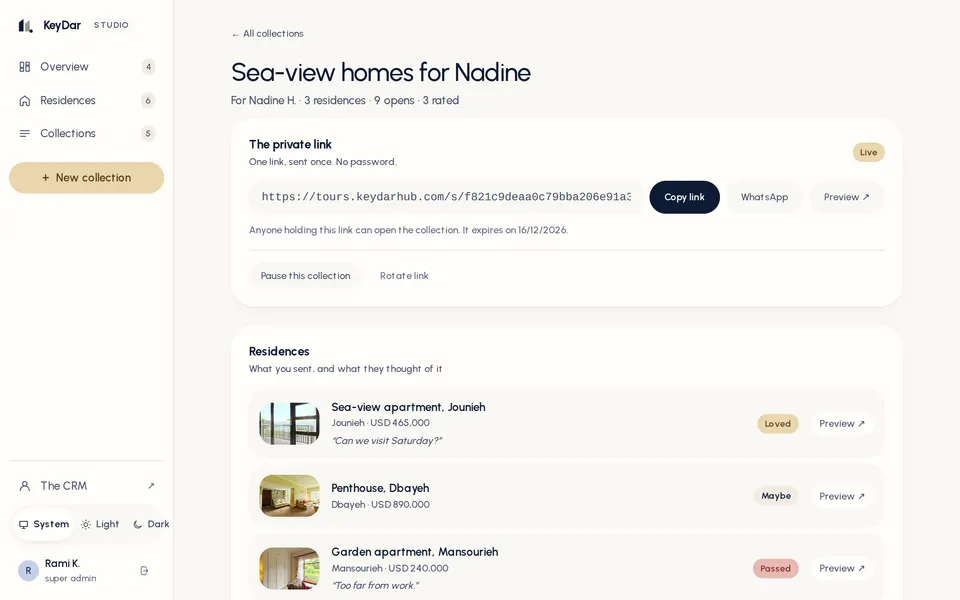
One private link per client, with their verdicts — shown with sample data 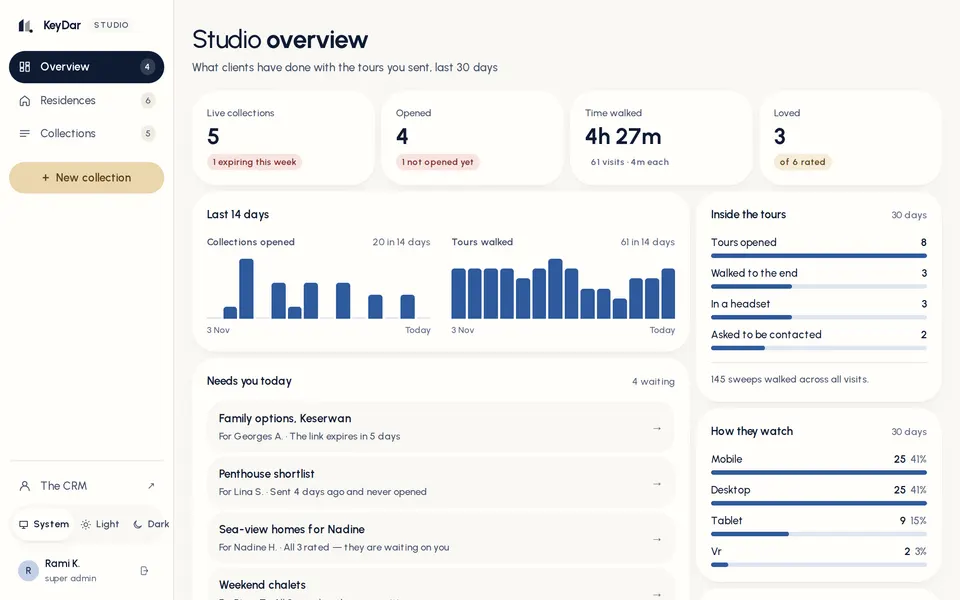
What clients did with the tours they were sent — shown with sample data 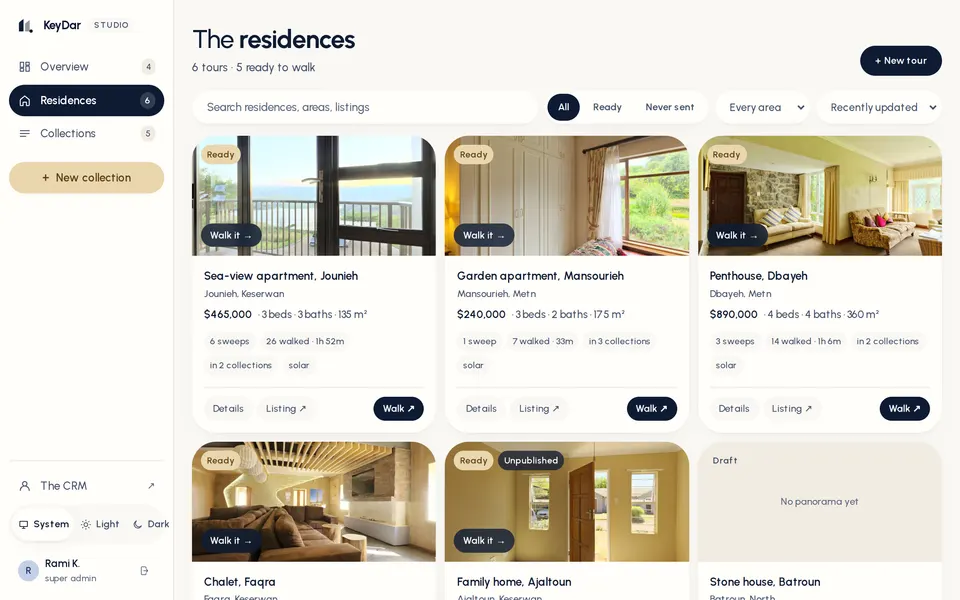
Every tour in the library, ready to walk or send — shown with sample data


Work in this industry


Buyers abroad
Built for buyers who aren’t here yet.
Many buyers of Lebanese property live in the Gulf, Europe or further away. They decide from photos, tours and conversations at odd hours, and they want proof before they fly in.
So the portal answers in English and Arabic, every listing is one tap from WhatsApp, the map shows the neighbourhood and what is around it without giving away the address, and a 360° tour goes out as a private link the buyer walks on a phone, a laptop or a headset, with no app to install.
- WhatsApp on every listing
- English and Arabic
- Private 360° tour links
- The area, not the address
- Every lead with its source
How we
work
Sketch
Week 1
We sit with your agents and back office, follow one lead from first message to signed deal, and choose what comes first: the portal, the CRM or the tours.
Design
Weeks 1–3
Listing pages, search and the CRM screens, designed around your brand and reviewed with your agents.
Build
Weeks 3–12
Built on a staging copy with sample listings and clients, so your real data stays untouched until go-live.
Launch
Go-live
We import your listings and contacts, connect your lead forms and WhatsApp, and train the team on their own records.
Care
Always
Hosting, backups, new features and the next market, from the people who built it.
Questions
From the journalCRM for clinics, real-estate agencies and schools in Lebanon
Can the website and the CRM be one system?
Yes, and that is how we build them. A listing is edited once in the console and published straight to the site, and every enquiry from the site lands in the CRM with its source and the agent who owns it. Bayview’s portal and console work this way.
Do 360° tours need special equipment?
A consumer 360° camera is enough. Its exports become rooms, which are linked through their real doorways and placed on a floor plan. Clients walk the tour in a browser on a phone, a laptop or a headset, with no app to install.
Can it handle new developments with many units?
Yes. Projects carry status labels and payment plans, and a building explorer shows which units are available, reserved or sold.
Will it work for buyers who search in Arabic?
Yes. KeyDar’s marketplace runs in English and Arabic, each on its own addresses with right-to-left Arabic, and its search understands English, Arabic, French and Arabizi.
Will the map show a property’s exact location?
Only if you want it to. Bayview’s map shows each property’s area and what is around it, from schools to drive times, never its exact location.
How long does it take?
A portal or a first CRM module is usually live in 6 to 12 weeks; tours and further modules follow one at a time. KeyDar went from first commit to public launch in about eleven weeks.
Other industries
Tell us how
your business runs.
Send a few lines on WhatsApp about your team and what slows it down. You’ll get an honest answer the same day, from the people who would build it.